

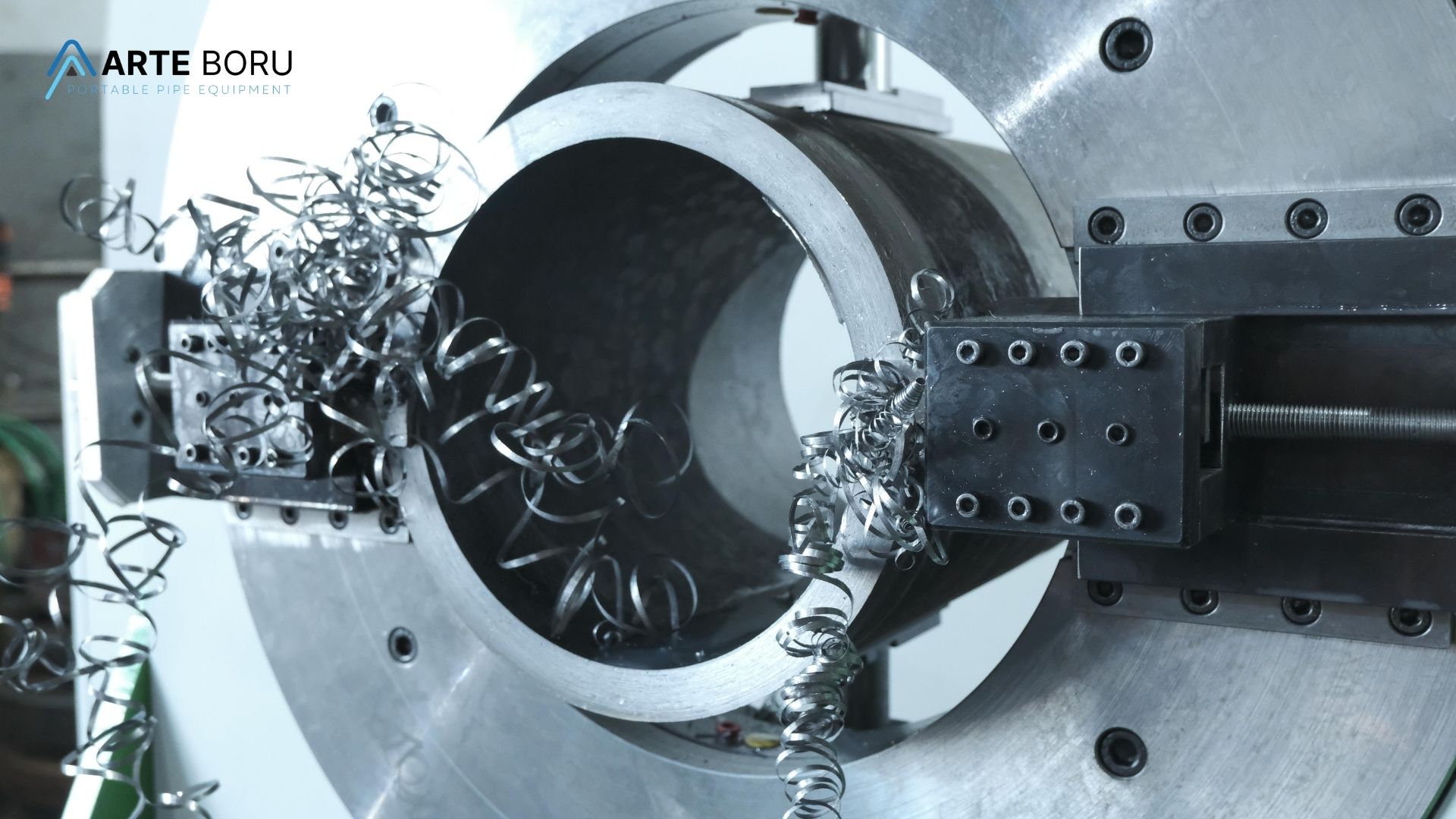
What Is Orbital Cutting? The Key to Precision and Efficiency in Pipe Cutting
Orbital cutting is a modern pipe and tube cutting method that provides high precision, repeatable quality, and maximum safety in industrial applications. It has become an industry standard especially in sectors where tolerance margins are extremely low, such as oil & gas, petrochemical, power generation, food, pharmaceutical, and nuclear industries.
In this comprehensive and SEO-optimized guide, you will learn what orbital cutting is, how it works, its advantages, where it is used, and why it is superior to conventional pipe cutting methods.
What Is Orbital Cutting?
Orbital cutting is a cold cutting process in which a cutting tool rotates 360° around a stationary pipe or tube, or the pipe is rotated in a controlled manner. During the cutting process, heat generation is kept to a minimum, preserving the metallurgical structure of the material.
Orbital cutting machines clamp the pipe internally or externally, ensuring perfect alignment. The cutting tool moves around the pipe at a constant speed and feed rate, producing a square, burr-free, and weld-ready cutting surface.
Why Is Orbital Cutting Preferred?
Traditional cutting methods such as angle grinders, band saws, or flame cutting often require secondary operations like grinding and facing. Orbital cutting eliminates these extra steps.
Key Advantages of Orbital Cutting
-
High cutting accuracy and squareness
-
Burr-free and smooth cutting surface
-
No additional preparation before welding
-
Minimal heat input (cold cutting technology)
-
Reduced operator dependency
-
Ideal for repetitive and serial operations
-
Safe for explosive and hazardous environments
Thanks to these advantages, orbital cutting is widely used in high-standard industrial projects.
How Does Orbital Cutting Work?
Orbital cutting machines consist of three main systems:
-
Clamping and centering system
-
Drive and rotation system
-
Cutting tool system
Once the machine is mounted on the pipe, precise centering is achieved to eliminate axial misalignment. The cutting tool then rotates around the pipe at a preset speed and feed rate. Constant pressure is applied throughout the cutting cycle, resulting in uniform cut quality along the entire circumference.
Types of Orbital Cutting Machines
External Clamping Orbital Cutting Machines
-
Clamped on the outer diameter of the pipe
-
Ideal for thin-wall pipes
-
Fast setup and portability advantages
Internal Clamping Orbital Cutting Machines
-
Centered from the inner diameter of the pipe
-
Suitable for thick-wall and large-diameter pipes
-
Provides excellent squareness and alignment
Orbital Cutting and Beveling Machines
These machines can perform both pipe cutting and weld beveling in a single operation, significantly reducing processing time, especially in field and site applications.
Industries That Use Orbital Cutting
Orbital cutting technology is widely applied across many industries, including:
-
Oil and gas pipelines
-
Refineries
-
Petrochemical plants
-
Power generation facilities
-
Shipbuilding and offshore platforms
-
Food and pharmaceutical processing plants
-
Nuclear industry
-
High-pressure process piping systems
Any application that requires leak-free welding and dimensional accuracy benefits from orbital cutting.
Orbital Cutting by Material Type
Carbon Steel Pipes
Carbon steel is one of the most common materials for orbital cutting. Standard HSS or carbide cutting tools provide excellent results.
Stainless Steel Pipes
Lower cutting speeds and controlled feed rates are recommended. Coated carbide tools ensure longer tool life and better surface quality.
Duplex and Super Duplex Pipes
Due to their high strength, these materials require specially designed carbide tools and carefully selected cutting parameters.
Aluminum and Copper Pipes
Higher cutting speeds are preferred. Proper chip evacuation is essential to prevent material buildup.
Orbital Cutting vs. Manual Pipe Cutting
| Criteria | Orbital Cutting | Manual Cutting |
|---|---|---|
| Cutting Accuracy | Very High | Low |
| Burr Formation | None | Yes |
| Heat Impact | Minimal | High |
| Weld Preparation | Ready | Additional work required |
| Safety | High | Medium |
This comparison clearly demonstrates why orbital cutting has become the preferred solution in modern industrial piping projects.
Common Mistakes in Orbital Cutting
-
Incorrect cutting tool selection
-
Excessive feed rates
-
Improper centering and clamping
-
Insufficient machine fixation on the pipe
Avoiding these mistakes ensures superior cutting quality and extends machine lifespan.
Maintenance and Long-Term Use of Orbital Cutting Machines
To achieve maximum performance and service life:
-
Clean the machine after each cutting operation
-
Inspect cutting tools regularly
-
Lubricate moving parts as recommended
-
Follow scheduled preventive maintenance plans
Conclusion: Why Choose Orbital Cutting?
Orbital cutting combines precision, speed, safety, and consistent quality in a single cutting solution. Conventional cutting methods no longer meet the requirements of high-standard industrial projects.
If your goal is perfect pipe cuts, weld-ready surfaces, and time efficiency, orbital cutting machines are a smart and future-proof investment.
This guide has been prepared as a reliable reference for engineers, procurement professionals, and technical teams seeking detailed information about orbital cutting technology.